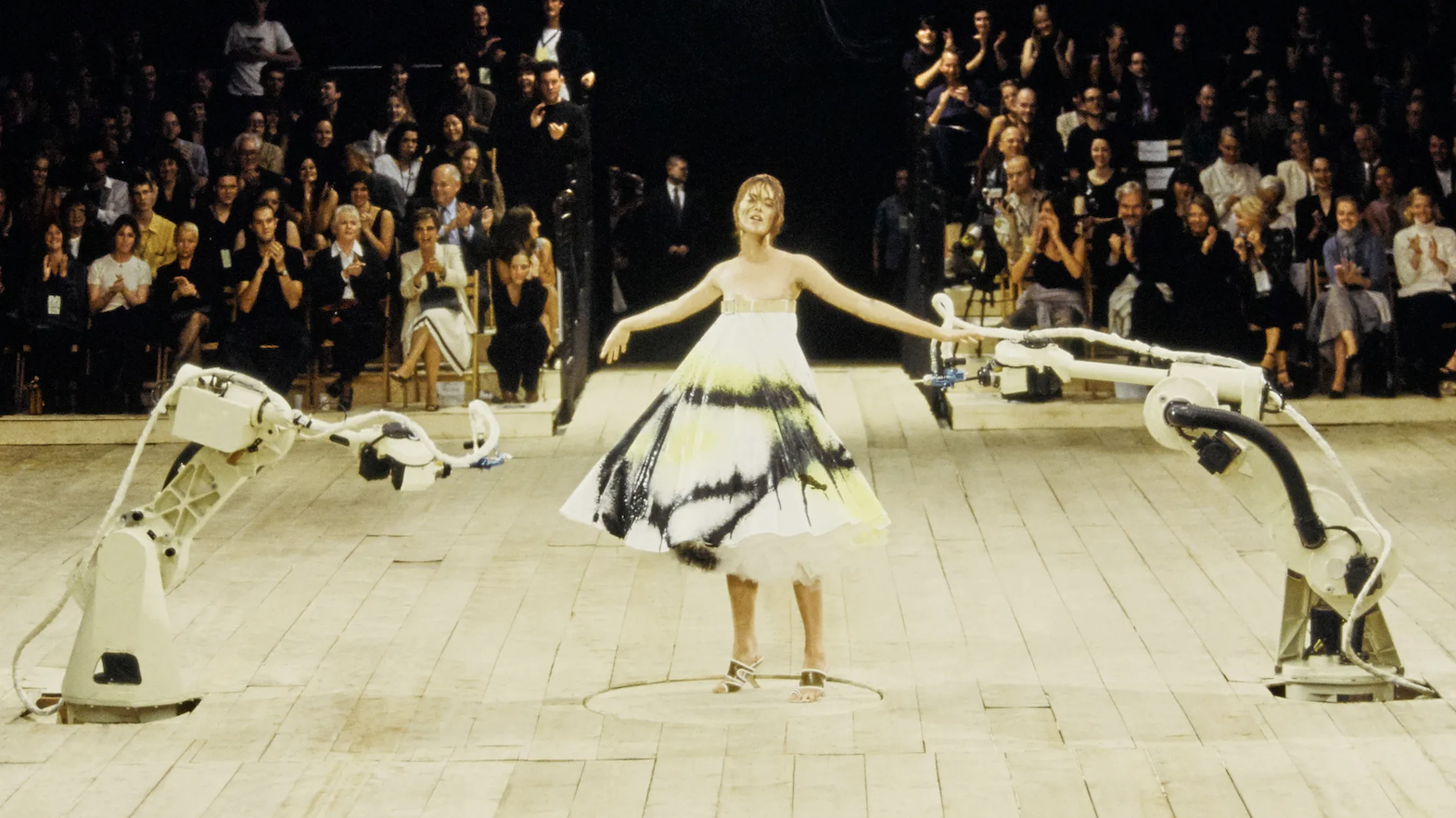
The last humans lived in a world quite similar to ours. But we wouldn't recognize it at all. Since the first stone tools, humanity has progressively reduced suffering by increasing its dominion over nature. Warmth succeeded cold, shelter succeeded exposure, medicine succeeded disease, abundance succeeded hunger.
The last humans realized human needs could be maximized by removing human vestigial structures and concentrating them into the highest density packing structure. Any need, from a sense of belonging to physical health, was satisfied since the society had a complete understanding of the machine Homo sapiens sapiens and nature was perfectly mutable. They refused to heavy alter their inner nature to maintain their connection to the species. Seas of neurons fulfilled needs for over 1036 humans throughout the universe and celestial structures were engineered to support these electrochemical systems.
They were wise and realized happiness was empty without meaning. Meaning came from attempting an objective with scarce resources, which was impossible after every need was immediately fulfilled. The step-by-step reduction in suffering away from the state of nature had led to the greatest form of suffering. Nothing is more entertaining than the folly of humanity. But the last humans were craftier than you and I could imagine in our wildest dreams; they placed themselves in a simulacrum with a quest and limitations, and wiped their memory as the world in world began. And the world was born again.
The last stars will die out 120 trillion years from now, followed by 10106 years of black holes. Big Bang, one second of stars, and a billion billion billion billion billion billion billion years of black holes. Within that big bright second, we're on a rocket ship headed towards utopia and the moment of ignition is firing right now.
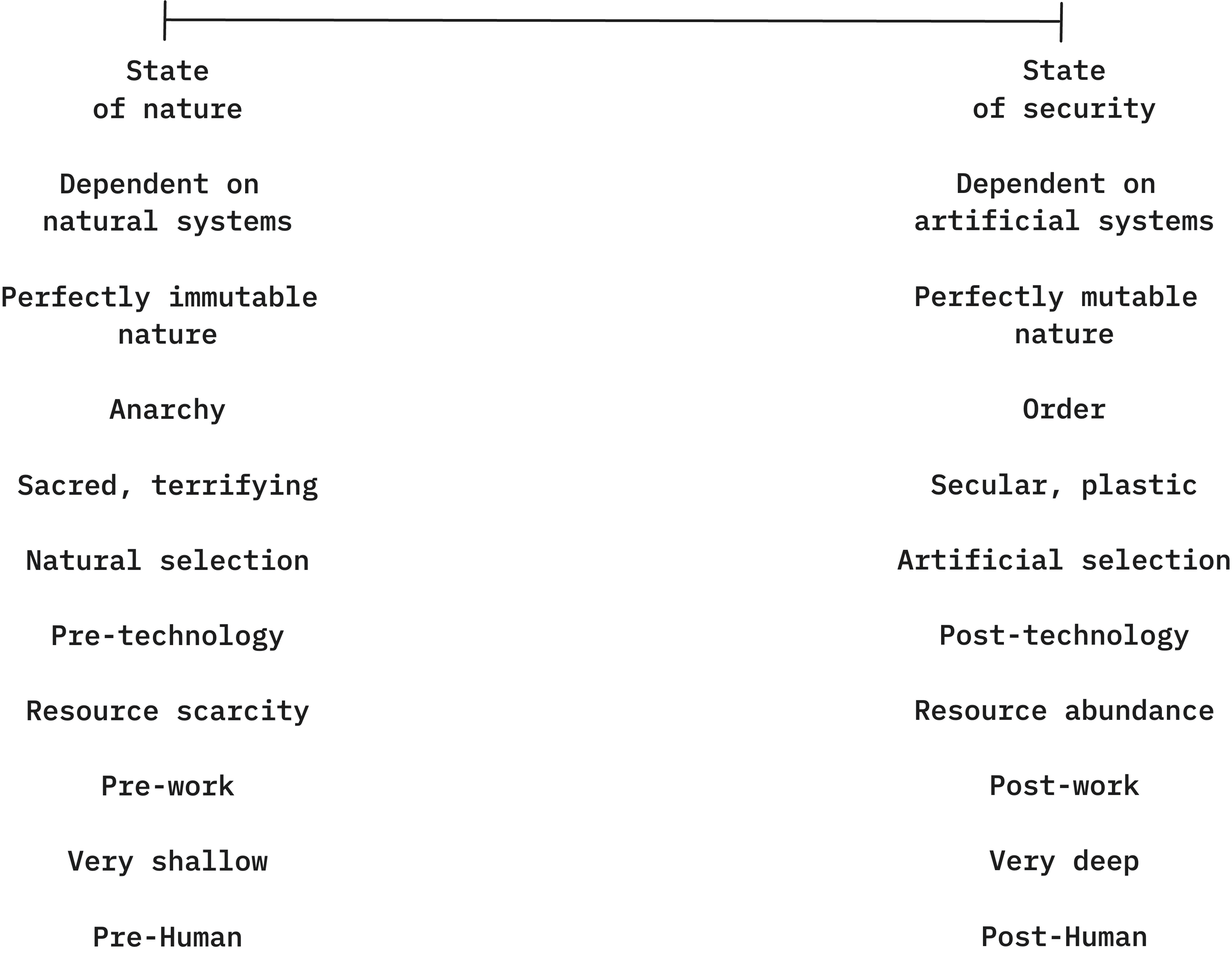
In a pure state of nature, we are under nature's mercy. A volcano could bury an entire town or a contagious plague can rapidly kill half the population (today, even though we are far from a perfect state of nature, both are still true). We have no power over nature, so we invent technology.
| Technology | Invented how long ago | What became mutable |
|---|---|---|
| Stone tools | ~3 mya, Australopithecus | flesh, wood, bone, force |
| Fire | 2.3 mya, Homo habilis | temperature, digestion, night |
| Agriculture | 10 kya, Homo sapiens | food supply, seasonality, land |
| Gears/water mills | 2.3 kya | muscle work |
| Gunpowder | 1.1 kya | violence, fortification, empire |
| Telescope | 400 ya | the visible cosmos |
| Electric light | 150 ya | day/night |
| Airplane | 120 ya | distance |
| Transistor | 80 ya | calculation, memory, coordination |
| CRISPR-Cas9 | 14 ya | heredity |
| Transformer | 9 ya | language, cognition, expertise |
Mathematics, physics, chemistry, and biology is nature's code we've inductively discovered and used to create machines that help us manipulate it. Machines, at their simplest form, are systems that multiply human work. More advanced machines multiply human agency. There is a natural asymptote at how much work a human can do.
| Technology | Energy source | Multiplication vs human |
|---|---|---|
| Human | Food | 1x |
| Animal power | Food | 10x |
| Language (Coordinated group of humans) | Food | 10-100x |
| Wind/water mill | Moving water/air | 10-1,000× |
| Steam engine | Coal | 100-10,000× |
| Calculator/computer | Various electrical | 106-1012x |
As machines get more advanced, our control over nature multiplies. Perfect technology would imply perfectly mutable nature, and that includes us as well.
A water wheel converts the natural energy of flowing water into mechanical rotational energy, which we can use to mill flour. Power looms automate weaving, making Luddites redundant. LLMs output code, which is used to create computational systems that computer engineers would write. Robots with vision-language-action models are on the brink of doing all housekeeping, industrial, and hospitality tasks.
When the humans hand-milling flour got replaced by a water wheel, engineering jobs to design, manufacture, and maintain the machines were produced. This is also shown across all technological growth across history: one class of human dependency is replaced by another. This argument is persuasive only while machines remain dependent on human maintenance, design, and reproduction. Once machines can maintain, design, and reproduce the machine ecosystem superior to humans, human labor (intellectual and physical) will be deeply redundant.
We can look at utopias from shallow to deep. In a shallow utopia, which we're making our way towards, we will produce a leisure culture. With an abundance of food, energy, land, etc., people can focus on raising children, hanging out, learning, gardening, debating, etc. Some people could shop all day and get into insane social signaling games (we're seeing a hint of this already in developed societies who already live with many forms of abundance). Limiting factors preventing our society from reaching this point faster include social systems, energy, manufacturing, compute, and materials. Court stenographers could have been replaced by whisper-large-v2 years ago but didn't. The world is slow to adopt stuff, and many times fights back, so it may take our entire lifetime to reach an early shallow utopia. Even with full automation, DJs, therapists, expensive hotel staff, and haute couture workers, among many other roles, would probably still be human for various reasons, but it would probably be the size of <1% of the current workforce.
For 96% of human history (288,000 out of 300,000 years), we lived in small, nomadic or semi-nomadic bands. We relied on foraging for wild plants, scavenging meat, and hunting animals. Some anthropologists argue we worked 3-4 hours a day, and spent the rest socializing, resting, or participating in religious and community rituals. After agriculture was developed and we moved into mechanized, factory-based mass production, (260 years ago) our current 9-5 system was born. The concept of a clock/wage, centralized workspaces, and specialization has existed for 0.09% of human history. Our metaphysical angst when thinking of a career or clocking into work everyday may be founded on strong evolutionary grounds even if the Protestants may disagree. Just ask my friends going to Goldman Sachs and Google—they do it to not have to work one day! But the world also looks very different from the existential, decentralized, kin-based way it used to be. Governments and allocation systems like capitalism will need to change to support the labor transition, since unemployment at a certain level will trigger calls for revolution. I'm excited for this, because it would mean our shallow utopia is rapidly approaching.
It's hard to predict what utopias beyond this point would look like since as we alter the outer nature with our machines, we will alter our inner nature too. This will change our most core desires, making any prediction impossible. It's also hard to have any value judgement on the future, like "changing nature is bad" or "a future where we are all hedonic neuron cubes is bad:" think about what our ancestors would say about the simulacra we've constructed today. The oldest texts, like The Old Testament or Bhagavad Gita offer timeless advice for humanity today since our inner nature has stayed constant even if our outer nature is completely different. We may be the last humans where this applies.
We may realize utopia requires anti-utopia. But we figured that out long ago.